What Your Brand Can Carry On
Bettina Dargie · 2026-09-28

I grew up in the Philippines, where ice cream is a gold tub. It's a red heart on the lid. It's the tenenen, tenenen, tenenene-nen of the ice cream man pedalling his trike up the street, and every kid on the block out the door before he makes the corner. That's the Selecta man. They’re so iconic that in 2025, they were able to run a billboard with no name and no logo on it at all.

The 2025 Selecta brandless billboard. No name or logos. Photo from Rappler Philippines.
Then I moved to the UK, opened a freezer, and there was that same red heart on a tub. Half a second of flashback (back home, a Selecta tub is not a promise of ice cream, because when moms needed a container, that tub can just as likely be last Sunday's adobo), and then I read the name on the lid. Wall's. Which meant it was definitely ice cream, and I was definitely not in the Philippines anymore.
A quick Google search revealed the heart answers to about twenty names. It's Streets in Australia, Algida in Italy, Langnese in Germany, Ola in the Netherlands, Kibon in Brazil, HB in Ireland, Miko in France, Good Humor in the States. This could easily be a traveller’s quest to create a Heartbrand passport and get it all stamped with the local names.

A map of Heartbrand logos with their local names. Map created by @linguemaps.
When the word is the problem
Sometimes the border just decides for you. Smarties in Canada are Nestlé's chocolate lentils. In the United States, Smarties are pressed sugar tablets made by an entirely different company. When those American tablets come north, they're sold as Rockets, because the name was already taken when they got here.

A box of Canadian Smarties and the Canadian Rockets. Photo from Toronto Mike.
Honda had a subcompact ready for Europe in 2001 called the Fitta, and worked out before launch that fitta is about the crudest available word for female genitals in Swedish, Norwegian and Danish. They renamed and launched the model as what is now known as the Honda Jazz.
It can go the other way. BMW arrived in China as 巴依尔, bā yī ěr, a straight phonetic run at Bayerische that meant nothing to anyone. The name it uses now is 宝马, bǎo mǎ. It keeps the B and the M sounds, and it means precious horse, an animal Chinese poetry has spent centuries tying to status and speed. The name they ended up with sells harder than the one they arrived with.
Sometimes the inside changes too
In June 2023 a personal shopper called Ray put two bottles of Heinz side by side on TikTok, one American and one Canadian. The US bottle lists high-fructose corn syrup and corn syrup where the Canadian one lists sugar, and the Canadian recipe starts from tomato paste rather than concentrate. It did 1.3 million views and five and a half thousand comments, most of them some version of “wait, what?”
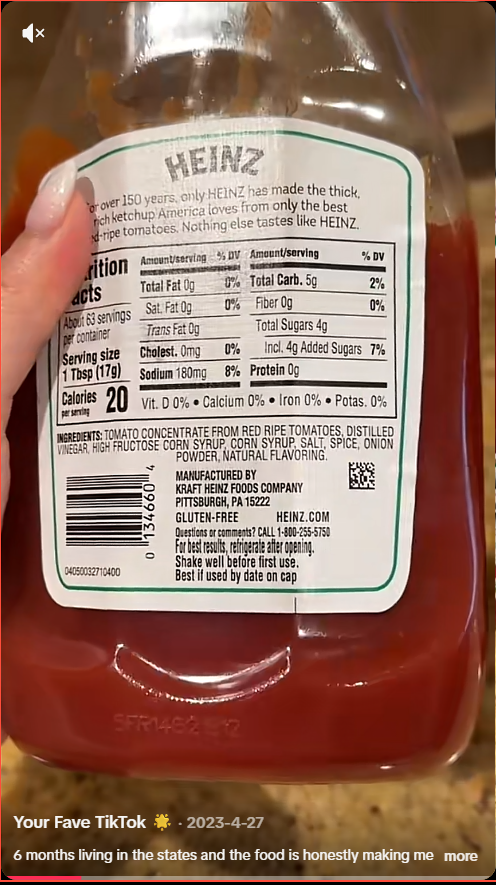
Video by @heyyitsrayyyy, 16 June 2023.
Fanta gets the same treatment, and you can see that from across the room. European Fanta is built on about 12% orange juice and coloured with carrot and pumpkin extract. The American version contains no orange juice at all and gets its colour from Yellow 6 and Red 40, which is why it's the brighter of the two by a distance.
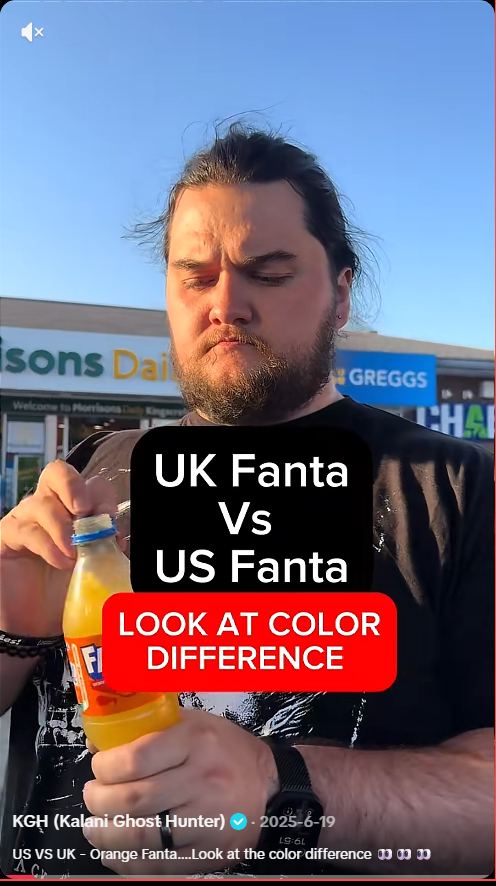
Video by @kalanighosthunter, 19 June 2025.
Oreo did the deliberate, industrial version of this. Kraft went through more than 20 formulations for the Chinese market before landing on one shoppers there actually wanted, shrank the packs so corner shops could afford to stock them, and took the brand from about 3% of the cookie market to roughly 15%.
Working out what has to give
Sometimes what has to give is the name, sometimes it's the product itself. Other times, it's the entire reason the thing exists: Häagen-Dazs is a premium pint from the grocery freezer in North America, and in China it went in through standalone boutiques, upholstered, with the line if you love her, take her to Häagen-Dazs. Around 80% of the revenue there comes through the parlours.
None of those were hunches. Behind each one is the boring part: what the word means out loud in the local language, what people already buy and what they'd never buy, what the category is worth and who already owns it, what expensive is supposed to feel like there. Sometimes that work comes back and tells you nothing needs to change, and you walk in exactly as you are. Sometimes it tells you that you're getting a new name, a new recipe and a new reason to exist, and the thing that travels is a red heart on a lid.
Make More Creative is an official partner of the Trade Accelerator Program and Level Up, both delivered by Calgary Economic Development with funding from the Government of Alberta.
TAP is a cohort program running about six weeks, from three days of workshops, mentorship day, and support throughout. Participants finish it with a formal export plan covering strategic objectives, market entry methods and an international marketing plan.
Level Up picks up from there. It goes deeper into individual markets and the harder ones to enter, through on-demand learning, expert-led workshops and one-to-one mentorship. Both programs are free to Alberta businesses.